
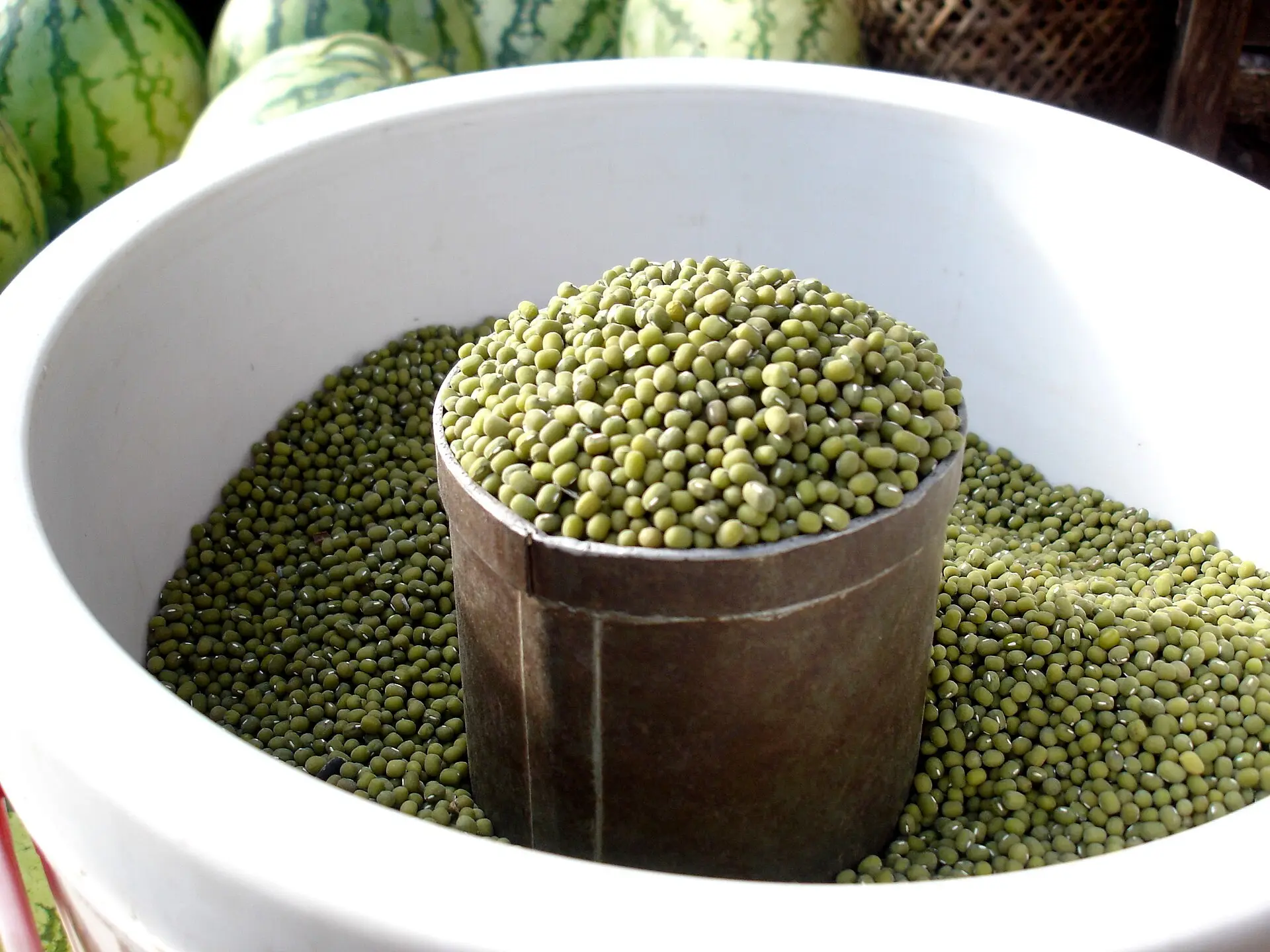
Varieties and grades
Shiny green gram, 3.5 mm and above
- Sieve size
- Typically 3.5 mm and above
- Moisture
- Typically 12% max
- Bruchid-damaged seeds
- Typically 1% max
- Immature and shrivelled seeds
- Typically 2% max
- Appearance
- Glossy, even bright green
Shiny green gram, 3.25 mm and above
- Sieve size
- Typically 3.25 mm and above
- Moisture
- Typically 12% max
- Bruchid-damaged seeds
- Typically 1% max
- Foreign matter
- Typically 1% max
Dull green gram, sized
- Sieve size
- 3.25 mm or 3.5 mm and above, as contracted
- Moisture
- Typically 12% max
- Appearance
- Matt seed coat, uniform green without shiny admixture
- Immature and shrivelled seeds
- Typically 2% max
Farm-cleaned lot, unsized
- Moisture
- Typically 13% max
- Foreign matter
- Typically 2% max
- Typical buyers
- Regional wholesalers and buyers with their own cleaning line
Specifications are typical trade parameters. The contract specification for each shipment is confirmed in the written offer.
Shiny and dull green gram: the two seed types buyers ask for
Green gram, known as moong in South Asia, ndengu or pojo in Kenya and choroko in Tanzania, is a small green pulse that cooks quickly. Buyers usually specify one of two seed types. Shiny green gram has a glossy seed coat and a bright green colour, and is usually the smaller seed. Dull green gram has a matt coat and is often larger. In Kenya these are commonly called the Nylon and Uncle types. Neither is better; the right one depends on the market being served. Size is fixed by sieve, for example 3.25 mm and above or 3.5 mm and above, and bolder lots cost more.
From farms in eastern Kenya and Tanzania to truckloads and containers
In Kenya the crop comes mainly from the dry eastern counties of Kitui, Makueni, Tharaka Nithi and Machakos, where it is planted in both rainy seasons. In Tanzania it is grown largely in the Lake Zone and the central regions. Farmers thresh and sun-dry the grain, and it is then bought through local traders and stores, cleaned, sized and bagged. We supply it two ways: by the truckload to packers and wholesalers within East Africa, and by the 20ft container against confirmed orders for buyers in India and Pakistan.
Rules for moving green gram across borders are not fixed. India has at times restricted moong imports by government notification, and Pakistan and the East African countries apply their own permits and plant health conditions. We check the position when you enquire and tell you plainly if a destination is closed or conditional at that time, instead of quoting for a shipment that cannot be cleared. Within East Africa, cross-border truck deliveries also need the correct plant health and origin documents, which we confirm case by case.
How a green gram sample is tested
Bruchids, the small beetles that bore into stored pulses, are the main risk in green gram, and infestation can start in the field. So before agreeing to buy, our staff inspect the lot at the store, probing bags from different layers and looking for live insects, eggs on the seed and bored grains. A weighed sample is sieved to confirm size, and the shrivelled, immature, discoloured and off-type seeds are separated and weighed, because a mix of shiny and dull seed, or of fresh and faded colour, lowers the value. Moisture is read on a meter.
Accepted lots are fumigated before loading, with a certificate, and bags are check-weighed. Export shipments are inspected by the national plant health authority for the phytosanitary certificate. If the buyer or the destination needs laboratory results, for example for pesticide residue, samples go to an independent laboratory and the report is passed to the buyer unchanged. We do not run a laboratory of our own; what we add is a person at the store who sees the lot before it moves.
Trade terms
- Packing
- Typically new 50 kg polypropylene bags; jute bags or other weights by agreement.
- Minimum order
- Typically one 20ft or 40ft container. Bulk orders only.
- Shipment
- Containers from Dar es Salaam or Mombasa to Mundra, Nhava Sheva (JNPT) or Karachi.
- Incoterms
- FOB Mombasa or FOB Dar es Salaam; CFR or CIF to the destination port by agreement.
- Inspection
- Independent inspection of quality and weight at loading, with our own team on site before the deal is closed and when the container is loaded.
- Documents
- Commercial invoice, packing list, bill of lading, certificate of origin, phytosanitary certificate and fumigation certificate as applicable.
Frequently asked questions
01Are ndengu, choroko and moong the same product?
Yes. Green gram is called ndengu or pojo in Kenya, choroko in Tanzania and moong or mung bean in India, Pakistan and international trade. One point to watch: in Tanzania the similar word dengu usually means chickpeas, so it helps to write green gram or moong in the enquiry to avoid confusion.
02Which sieve sizes of green gram do you offer?
The usual sized lots are 3.25 mm and above and 3.5 mm and above. What is available depends on the season and on the seed type, since dull seed tends to be bolder than shiny seed. Unsized, farm-cleaned lots are also offered to buyers who have their own cleaning and grading line.
03Can you deliver green gram by truck to a packer in East Africa?
Yes. Regional supply is done by the full truckload, delivered to the buyer’s warehouse or collected from the store by agreement. We do not sell small or retail quantities. Tell us the seed type, the size and the delivery point, and whether you need the grain machine cleaned or will clean it yourself.
04Can moong be imported from Kenya into India or Pakistan?
It depends on the rules at the time. India controls moong imports through government notifications and has restricted them in some periods, while Pakistan has its own import and plant quarantine conditions. Before quoting we check whether the shipment can be cleared, and the importer should confirm the same with a customs broker in the destination country.
05What most often causes a green gram lot to be rejected?
The common reasons are live bruchids or bored seeds, moisture above the contract limit, too many shrivelled or immature seeds, and mixed colour or mixed seed type. All four can be seen on a properly drawn sample, which is why the lot is sampled and counted at the store before purchase and not judged from a handful shown by the seller.